.png?width=250&height=150&name=Untitled%20(46).png "InfoReady logo")

InfoReady Automation Brings Improvements
Amy Gantt: Essentially, we were spending a lot of time manually managing both internal funding and limited submissions (before).
InfoReady had the potential and has shown to really reduce the administrative burden for all of the different programs that we're using it for. It's reduced our email volume, though not eliminated it entirely. We're able to request documents, recruit reviewers, members, follow up with reminders that are more automated, and provide official approvals for both internal funding and limited submissions.
And the InfoReady platform has provided us as administrators, those who are applicants, and those who are reviewers with a single user-friendly platform that has replaced the multitude of platforms we were using previously. It allows for more automated data collection and analysis, which helps us to continue to advocate, particularly for our internal funding programs.
Powering Seed Programs and More
Mustafa Humayun: Our footprint within the system is primarily centered on the seed programs, Springboard Research and Scholarship, and the Muse Arts and Humanities and Humanistic Sciences Award, which are funded via the OVPR, the Office of Vice Provost for Research. But besides that, we have also evolved into helping other programs.
Intra-institutionally, we supported a competition for a Task Institute of Artificial Intelligence, as well as we have been managing Springboard Education, which is a separate grant program from the research and scholarship pipeline. And recently, we got a new request from the faculty for introducing a new program that's the neuro engineering pilot grant program.
So our programs have also grown in terms of Springboard Research and Scholarship. The last cycle received 29 applications. This cycle received 56 applications. That shows how much more difficult it would have become for us if we were doing it manually without InfoReady. Overall, that has been very helpful.
In terms of how InfoReady is powering our internal seed programs, another key value of InfoReady is how it enables expansion across school and departments.
Once faculty and administrators have become more familiar with the platform, it has naturally encouraged other units to adopt it for their own internal programs. We have been able to provide us be that central department or role where we are able to help them implement these programs and strategies.
This type of intra-institutional expansion has mattered to us because it creates consistency in the process, simplifies training and support, as well as improves visibility across units, and it also reduces duplication of effort.
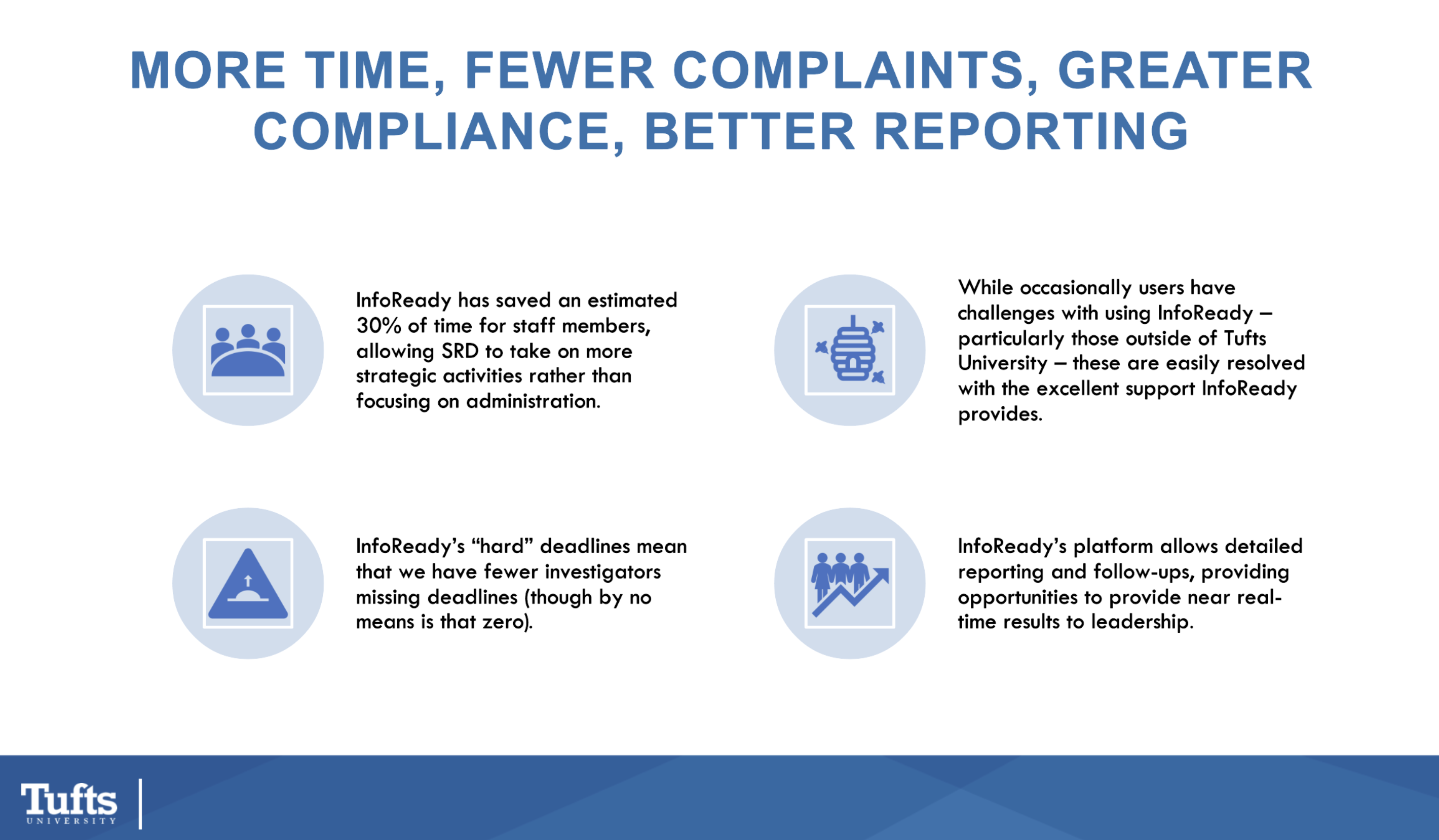
“InfoReady has saved an estimated 30% of time for staff members across all of us who are working on these different projects. That allows us to take on more strategic activities rather than focusing so much on administration”.

Amy Gantt Director of Strategic Research Development

Using InfoReady for Research Development & High Profile Events
Watch the recording of Peer Spotlight webinar.

How Tufts University Scaled Internal Funding and Limited Submissions
Tufts used manual processes that limited growth & were error prone, so they adapted InfoReady.

How Tufts University Scaled Research Development with InfoReady
Read how Tufts’ Strategic Research Development team adapted modern workflows.
Using InfoReady for Research Development & High Profile Events
View the slides from the Tufts' presentation.